What Is WPC Wall Panel for Household Use?

Time:2026-10-19 Author:Charlotte
0%

A Wpc Wall Panel For Household use is designed to bring practical surface protection and decorative appeal into everyday rooms. WPC usually combines wood fibers with thermoplastic materials. This blend can create panels with a warm wood-like appearance and improved resistance to routine moisture. Homeowners often consider them for living rooms, bedrooms, hallways, kitchens, and covered balconies.

Look closely at the installation area. A panel beside a sink may face splashes, steam, and frequent cleaning. A hallway panel may need to resist shoes, bags, and accidental knocks. Proper wall preparation matters. The surface should be dry, reasonably level, and free from dust. Installers commonly use suitable adhesive, clips, or a supporting frame, depending on the panel design. Small gaps may also be necessary for movement caused by temperature changes.

It is not a perfect solution. WPC panels can still scratch, fade, or deform when exposed to excessive heat. Quality also varies between suppliers. Check the product specifications, fire performance, formaldehyde information, and recommended cleaning methods before purchase. Reliable manufacturers should provide clear technical data and installation guidance. Avoid assuming that every “waterproof” claim means full protection in wet areas.

A soft cloth is usually enough.

Routine care helps preserve the finish. With sensible selection and careful installation, WPC wall panels can offer a clean, durable upgrade for many household interiors. Yet the best choice depends on room conditions, ventilation, budget, and long-term expectations.
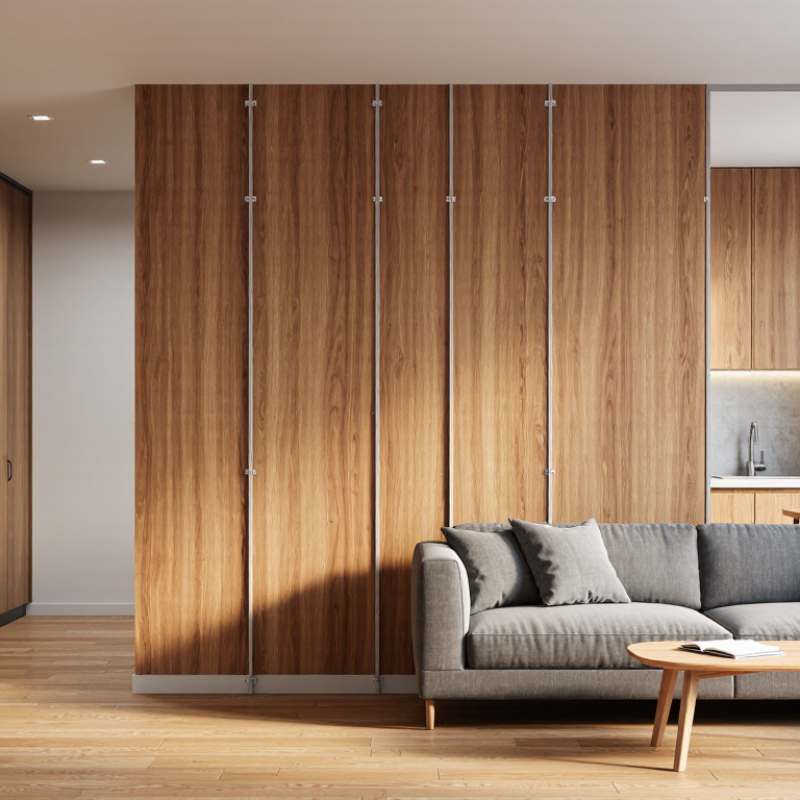
What Is WPC Wall Panel for Household Use?

Definition and Basic Structure of WPC Wall Panels

WPC wall panels are decorative interior boards made from wood fibers or wood flour, thermoplastic resin, and carefully measured additives. WPC means wood-plastic composite. The material is formed under heat and pressure, usually through an extrusion process. This creates a consistent panel with a wood-like appearance and improved resistance to everyday moisture. It is designed for household walls, not for carrying structural loads.

The basic structure usually includes a dense WPC core, a decorative surface, and sometimes a protective coating. The core gives the panel stiffness and helps reduce minor impacts. The surface may imitate oak grain, stone texture, or a smooth painted finish. Some panels are solid, while others contain internal cavities to reduce weight. Interlocking edges or simple backing systems can make installation faster. In practice, wall flatness matters more than many beginners expect. Small uneven areas may become visible after fitting.

Tips: Check the panel thickness, edge profile, and installation instructions before cutting. Leave a small expansion gap near floors, ceilings, and corners. WPC resists splashes, but it is not completely waterproof. Keep untreated edges away from constant standing water. Use accurate measurements. A careless first cut can waste a full panel. Cleaning is usually simple with a soft cloth and mild detergent. Avoid abrasive tools, because they can dull the protective surface. I have found that choosing texture carefully matters too; deep grooves collect dust and need more frequent cleaning.

Materials, Manufacturing Process, and Surface Designs

What Is WPC Wall Panel for Household Use?

WPC wall panels combine wood fibers or flour with thermoplastics, such as PVC, polyethylene, or polypropylene. Small amounts of stabilizers, pigments, and processing aids improve strength and color retention. Grand View Research reported that the global wood-plastic composites market was valued at about USD 7.4 billion in 2023. Its forecast also indicates continued growth through 2030, supported by construction and interior applications.

Manufacturing usually begins with drying and blending the wood filler with polymer pellets. The mixture is heated, compounded, and pushed through an extrusion die. Cooling calibrates the panel’s shape. Later, manufacturers may add a decorative film, paint layer, or embossed surface.

I have found that surface texture affects installation more than many buyers expect. Deep grooves can hide uneven walls, but they collect dust. Smooth finishes clean faster.

Design choices now include wood grain, stone patterns, matte colors, and narrow slat profiles. A 2024 report from Grand View Research identifies decorative applications as an important demand area for WPC products. However, printed surfaces are not automatically durable. Poor bonding, excessive heat, or prolonged moisture can cause fading or edge swelling.

That deserves attention. Household users should check the core composition, surface coating, fire-performance documentation, and recommended cleaning method. WPC is practical, but it is not maintenance-free.

Common Household Applications of WPC Wall Panels

What Is WPC Wall Panel for Household Use?

WPC wall panels combine wood fibers with thermoplastic materials. They create a firm, decorative surface for residential interiors.

Grand View Research valued the global WPC market at about USD 7.14 billion in 2022.

Its report projects a 7.5% annual growth rate from 2023 to 2030. Building applications remain a major demand area.

Common Household Applications of WPC Wall Panels

In living rooms, panels can form a warm feature wall behind a sofa or television. Their repeating grain adds texture without heavy masonry work.

In bedrooms, they can frame a headboard and reduce visible scuffs near bedside furniture. Hallways also benefit from wipeable surfaces, especially around children’s bags and shoes.

Kitchens may use WPC panels on dry backsplash areas or dining walls. However, they should not replace waterproof systems beside sinks.

Bathrooms need extra care. WPC can resist occasional moisture, but poor ventilation may cause expansion, mold growth, or adhesive failure.

The U.S. Environmental Protection Agency notes that indoor pollutant levels can reach two to five times outdoor levels. Low-emission adhesives and regular ventilation therefore matter.

A practical installation check includes wall flatness, expansion gaps, and concealed wiring.

Panels are not maintenance-free. Cuts can expose the core, and dark colors may reveal dust quickly.

This is an imperfect material, but thoughtful placement improves its household value.

Always confirm fire, moisture, and indoor-emission documentation for the intended room.

Installation Methods and Essential Preparation Steps

What Is WPC Wall Panel for Household Use?

WPC wall panels combine wood fiber and thermoplastic resin for interior wall decoration. Their moisture resistance suits kitchens, bathrooms, and entrance areas, but they are not automatically waterproof. Grand View Research’s 2024 Wood Plastic Composites Market report identifies construction as a major application sector. That growth does not remove installation risks.

Preparation controls most problems. Check the wall with a two-meter straightedge. Uneven areas can cause visible gaps and panel stress. Keep the panels indoors for at least 48 hours, allowing them to match room temperature. Measure wall moisture before covering masonry. The U.S. Environmental Protection Agency reports that indoor pollutant levels can be two to five times higher than outdoor levels. Ventilation matters, especially after using adhesive.

Choose the method according to wall condition. Construction adhesive works on clean, dry, stable surfaces. Screws or clips provide stronger mechanical support on timber framing and uneven walls. Furring strips create a service cavity, but they reduce room space. Leave a small expansion gap at corners and around the ceiling. Follow the panel’s tested fire rating; ASTM E84 results should not be guessed from appearance. I usually install one trial panel first. It feels slow. Yet it exposes bad spacing, weak adhesive, or a crooked starting line before the full wall is covered. EPA moisture-control guidance also supports repairing leaks before installing decorative finishes.

What Is WPC Wall Panel for Household Use?

Typical installation planning time for 10 m² of WPC wall panels by installation method.

Direct adhesive installation is usually the fastest option when the wall is clean, dry, flat, and structurally sound. Clip or screw installation takes longer because it commonly requires battens, accurate leveling, pilot holes, or additional fixing hardware. These are practical planning ranges rather than manufacturer specifications; wall condition, panel size, cutting requirements, and installer experience can change the actual time.

Advantages, Limitations, and Maintenance Requirements

What Is WPC Wall Panel for Household Use?

Advantages, Limitations, and Maintenance Requirements

WPC wall panels combine wood fibers with polymer materials. They create a warm, textured surface without the weight of solid timber. In household rooms, they can cover uneven walls and reduce minor decorative repairs. Their main advantage is moisture resistance. This makes them practical for kitchens, hallways, and well-ventilated bathrooms. However, moisture resistance does not mean complete waterproofing. Water can still enter through open joints or damaged edges.

Installation quality strongly affects performance. Panels need expansion space near corners, ceilings, and floors. Without it, seasonal temperature changes may cause buckling or visible gaps. A level wall surface also matters. Small errors can become obvious under strong side lighting. Fire ratings, indoor air-quality data, and formal installation instructions should be checked before purchase. These details are sometimes overlooked.

Maintenance is simple but not careless. Dust the surface with a soft, dry cloth each week. Use a damp cloth for ordinary marks, then dry the panel promptly. Avoid abrasive powders, hard brushes, and strong solvents. They may dull the finish or weaken the protective layer. Inspect joints near sinks and windows every few months. Repair loose edges early. Waiting usually makes the damage harder to control. WPC panels are convenient, but I would not treat them as maintenance-free. Their appearance depends on accurate installation, gentle cleaning, and realistic expectations.

What Is WPC Wall Panel for Household Use? - Advantages, Limitations, and Maintenance Requirements

Data Dimension Verified General Information Household Considerations
Definition WPC stands for wood-plastic composite. WPC wall panels are interior wall-covering products made from a mixture of wood-based fibers or powder, thermoplastic polymers, and additives. The exact formulation varies by product. Check the product specification sheet before installation because composition, density, surface finish, and performance can differ significantly between panels.
Typical Household Locations Common indoor applications include living rooms, bedrooms, hallways, home offices, television walls, and decorative feature walls. Use the panels mainly in dry or normally humid interior areas unless the product is specifically rated for higher-moisture environments.
Appearance Advantage
Panels are available in wood-look, textured, grooved, slatted, and laminated decorative surfaces. They can provide a more uniform appearance than many natural wood wall finishes.
Color and texture consistency can simplify the creation of an accent wall, but samples should be reviewed under the room’s actual lighting conditions.
Moisture Resistance Advantage
Many WPC panels resist occasional splashes and absorb less moisture than untreated wood. However, “water-resistant” does not automatically mean “waterproof.”
Seal joints and edges where required, prevent prolonged water exposure, and avoid using standard interior panels in areas with continuous moisture unless the manufacturer permits it.
Dimensional Stability Advantage
WPC generally has better resistance to ordinary humidity-related movement than solid wood, although expansion and contraction can still occur with temperature changes.
Leave the recommended expansion clearance at edges and around openings. Do not install panels tightly against floors, ceilings, or adjoining walls unless the system is designed for it.
Installation Depending on the panel system, installation may use adhesive, screws, clips, battens, or a combination of fixing methods. A reasonably flat, clean, and dry substrate is normally required. Plan electrical outlets, corners, skirting boards, and door or window trims before fixing the panels. Heavy objects should be anchored to the wall structure rather than relying only on the panel.
Cutting and Finishing Advantage
WPC panels can usually be cut with common woodworking tools, but the cutting method depends on panel density, surface coating, and internal structure.
Use eye protection and suitable dust control. Protect or finish exposed cut edges when the panel system requires it, particularly near areas where moisture may occur.
Cleaning Maintenance
Routine cleaning generally requires a soft cloth or microfiber duster. For marks, use a damp cloth with mild soap or a neutral household cleaner, followed by drying.
Avoid abrasive pads, aggressive solvents, bleach-based products, and excessive water because they may dull, stain, or damage the decorative surface.
Stain and Scratch Care Maintenance
Surface durability depends on the overlay or finish. Some decorative coatings resist everyday marks, but no ordinary wall panel is completely scratch-proof or stain-proof.
Remove spills promptly, keep sharp furniture edges away from the surface, and test any cleaning product on an inconspicuous area first.
Heat Exposure Limitation
WPC contains thermoplastic material and may deform, discolor, or deteriorate when exposed to excessive heat or a direct heat source.
Maintain a safe distance from stoves, heaters, fireplaces, radiators, and high-temperature lighting. Follow the product’s stated temperature and clearance requirements.
Fire Performance Limitation
Fire behavior varies by formulation and construction. A WPC panel should not be assumed to be fire-rated simply because it is intended for interior use.
Review the applicable fire-test classification for the intended building and room before installation, especially in corridors, public areas, or multi-unit housing.
Vapor and Ventilation Limitation
Panels can conceal damp substrates, leaks, or condensation if installed over an unsuitable wall. Covering moisture problems may lead to mold or substrate damage.
Inspect and dry the wall before installation. Address leaks, rising damp, or condensation issues first, and provide ventilation where the installation system requires it.
Indoor Air Quality Selection Factor
Emissions depend on the polymers, adhesives, coatings, additives, and wood content used in the product. Performance claims should be supported by relevant test documentation.
For bedrooms, nurseries, and poorly ventilated rooms, request indoor-air-emission information and ventilate the space during and after installation.
Acoustic Effect Limitation
Decorative WPC panels may reduce some reflected sound, particularly when combined with grooves, gaps, backing layers, or absorbent materials. A thin solid panel alone does not provide comprehensive soundproofing.
For meaningful acoustic improvement, consider the full wall assembly, including an appropriate backing or sound-absorbing layer, rather than relying on the visible panel alone.
Expected Service Life Depends on Conditions
Service life is affected by material formulation, installation quality, sunlight, heat, moisture, cleaning chemicals, and mechanical impact. A universal lifespan cannot be assigned to all WPC panels.
Use the warranty and technical documentation for the selected product, and inspect joints, edges, fasteners, and surface finish periodically.
Repair and Replacement Limitation
Minor surface marks may sometimes be cleaned or cosmetically treated, but deep scratches, warping, delamination, or severe water damage may require panel replacement.
Keep spare panels from the original installation because later batches may differ in color, texture, profile, or dimensions.
Environmental Considerations Selection Factor
WPC can incorporate wood residues and recycled polymers, but environmental performance depends on the actual recycled content, sourcing, additives, product life, and end-of-life options.
Ask for verified recycled-content, responsible-sourcing, or environmental documentation rather than assuming that every WPC panel has the same environmental profile.

FAQS

What are WPC wall panels made from?

They combine wood fibers, thermoplastic resin, and measured additives. Heat and pressure form the panel into a stable decorative board.

Can WPC wall panels support structural loads?

No. They are decorative interior coverings, not structural building materials. Use suitable framing for shelves, cabinets, or heavy fixtures.

Where can WPC wall panels be used at home?

They suit living rooms, bedrooms, hallways, and dry dining areas. A feature wall behind a sofa can add warmth and texture.

Are WPC panels suitable for kitchens and bathrooms?

They may work in dry kitchen areas and well-ventilated bathrooms. Avoid constant water near sinks, showers, and untreated edges.Not completely waterproof.

What should be checked before installation?

Check wall flatness, panel thickness, edge profiles, and concealed wiring. Leave small expansion gaps near floors, ceilings, and corners.Measure twice.

Are WPC wall panels easy to clean?

Usually, yes. Wipe them with a soft cloth and mild detergent. Deep grooves may collect dust and require more frequent cleaning.

Can WPC panels become damaged during cutting?

Yes. Incorrect cuts can waste an entire panel. Exposed cores may absorb moisture, so measure carefully and protect cut edges.A careless cut hurts.

Do WPC wall panels require regular maintenance?

They need some maintenance, despite their convenient surface. Watch for expansion, loose adhesive, dust buildup, and damage around corners.They are not maintenance-free.

Are all WPC wall panels solid?

No. Some panels are solid, while others contain internal cavities for lower weight. Review the product structure before choosing fasteners.

What safety details matter indoors?

Confirm fire behavior, moisture suitability, and indoor-emission documents for the intended room. Choose low-emission adhesives and maintain regular ventilation.Good installation is not enough.

Conclusion

A Wpc Wall Panel For Household use is a decorative and functional wall-covering product made from a blend of wood fibers and thermoplastic materials. Its basic structure usually includes a durable composite core and a finished surface designed to imitate wood grain, stone, or other textures. During production, the materials are mixed, shaped, cooled, and treated with surface coatings or patterns to improve appearance and everyday performance. These panels are commonly used in living rooms, bedrooms, hallways, kitchens, and other indoor areas where homeowners want a clean, modern, and easily maintained finish.

Before installation, the wall should be dry, level, clean, and free from loose materials. Depending on the wall condition and panel design, installation may involve adhesive, clips, screws, or a supporting frame. WPC panels are valued for their moisture resistance, stable structure, decorative variety, and simple cleaning requirements. However, they may expand or contract slightly with temperature changes, can be affected by excessive heat, and may require careful cutting during installation. Regular dusting and gentle cleaning are generally sufficient for maintenance.


Charlotte

Charlotte

Charlotte is a seasoned marketing professional with a deep understanding of the company's portfolio and a passion for elevating its presence in the market. With a keen eye for detail and a commitment to excellence, she ensures that our professional blog is regularly updated with insightful articles......